Punch & Chisel Complete Guide

Find The Right Punch & Chisel For Your Needs

Punches and chisels have been used for countless decades, originally to complete survival tasks such as woodcarving, forming stone, and preparing and fabricating clothing. Today, hand held punches and chisels are used for removing pins and bushings, and cutting or splitting steel objects. This guide will take a closer look at the many types, shapes, designs and specific functions of each tool.

Punches

Punches can be generally grouped into one or two types: hollow and solid. This guide will focus on the solid type.

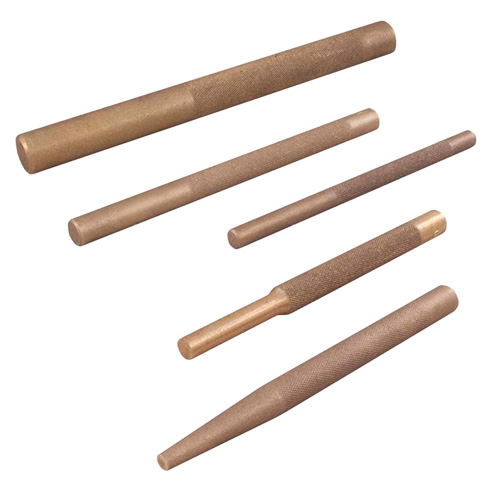
Solid punches are solid single-piece rod-shaped tools made of metal designed to be struck by a hammer. They are usually used to drive objects such as pins or to form impressions on work surfaces. Varying in length, diameter and tip size, each punch is designed to suit the job to be completed.

Types of Punches

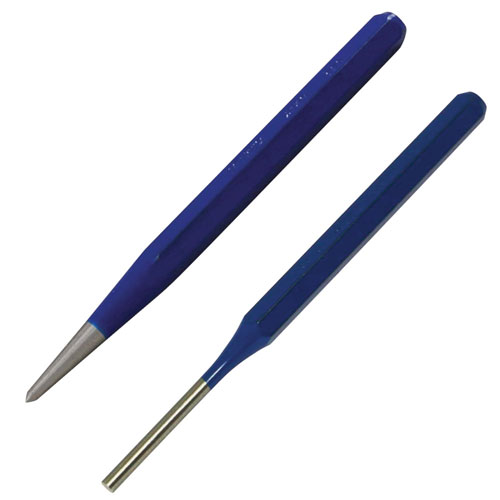
  • Pin Punches: Best suited to drive or remove pins and ideally used once a pin has been loosened by a taper punch, pin punches feature a long head in the same diameter as the tip. The proper size for a project is where the tip is smaller than the encasing hole yet large enough to make solid contact with the pin to be removed or driven.
  • Pilot Punches: Commonly known as roll pin punches, they are designed to drive or remove hollow tension pins, such as tapered and rolled, or solid pins. They have a similar long head like a pin punch with a slight bump at the tip permitting insertion into a rolled pin.
  • Taper Punches: Designed to loosen and drive pins, taper punches can also be used to align existing holes between multiple work pieces before fastening or riveting.
  • Centre Punches: Used to create a mark on a material where a hole is to be drilled later. Upon being struck, a small indentation is made in the workpiece. The indentation allows a drill bit to penetrate the material more easily, while simultaneously reducing bit walk and possible marring of the workpiece.
  • Prick Punches: Similar to the center punch only it is designed for use on soft materials such as wood, plastics, and thin sheet metal. May also be used to scribe marking lines prior to cutting or riveting.
  • Aligning Punches: Ideal for aligning two or more holes in order to allow the insertion of a fastener. Their tapered body allows holes to easily be grouped and aligned as the punch is inserted. They are not meant to be struck and therefore not recommended for driving pins, rivets, or bolts.

Choosing the Right Punch

Proper tool selection for the job dramatically improves efficiency and tool life. Punches with tapered heads are specially heat-treated for maximum strength and designed to take the impact needed to loosen pins. Conversely, punches with long straight heads are not designed to resist heavy strike blows and, when misused, will bend or break. The proper method for breaking loose a pin is to start with a taper punch then switch to the pin punch. As such, it is ideal for technicians to have a matching tapered punch for every pin punch in their toolbox.

Chisels

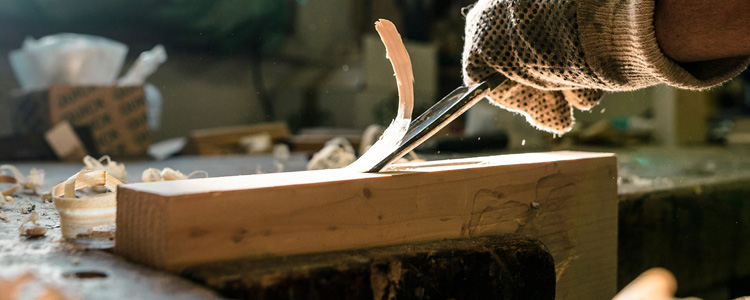
Similar to punches, hand chisels can be also classified into several types: wood, masonry, and metalworking. This guide will focus on the metalworking chisels.

Like solid punches, metalworking chisels are metal single-piece rod shaped tools designed to be struck by a hammer. Their primary function is to cut or shape metal.

Types of Chisels

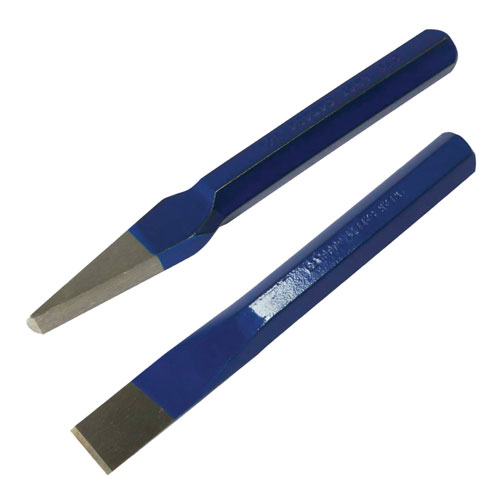
  • Flat Chisels: The most common of all metalworking chisels and often-called "cold chisels", flat chisels feature a flat wide tip (working end) with a cutting edge. The size of the chisel is determined by the width of the tip. Common applications include breaking chain, removing burrs, and cutting bolts.
  • Rivet Buster Chisels: Rivet buster chisels have the same characteristics as flat chisels with the exception they feature an offset cutting edge, which allows the chisel to lay flat and easily slide under the rivet to be removed.
  • Diamond-Point Chisels: Named for their distinct diamond shaped point. Designed to punch holes and make V-shaped grooves in sheet steel.
  • Cape Chisels: They feature a narrower cutting edge than flat chisels. Designed to square rounded corners in grooves or cut new grooves with square edges in steel.
  • Round Nose Chisels: Similar to cape chisels, although instead of a straight edge they feature a round edge on one side. The round edge allows them to cut grooves with round bottoms.

Choosing the Right Chisel

Chisels are extremely useful for cutting steel objects and materials. It is important to always ensure the object(s) being cut or worked on is not harder than the chisel being used. Failure to do so will almost surely result in the chisel’s point dulling or being destroyed. Should this occur the best way to re-sharpen the chisel is to re-file its cutting edge using a hand file. Never use, a grinder as doing so could result in the chisel losing its temper. The head diameter of the hammer should never be more than 3/8" larger than head of chisel or punch. Finally, never use a pair of pliers to hold a chisel as they will create sharp indentations that can endanger a user's hands when handling later on. Instead, always use a proper punch or chisel holder.

Punch & Chisel Maintenance

Maintenance

Regular maintenance is a very important step in preserving a tool's useful life.

Most punches and chisels are differentially tempered making their striking end softer than their working end. As such, when any punch or chisel mushrooms on the striking end, it must be dressed to prevent the mushrooming pieces from chipping off and causing harm. Conversely at the opposite end (working end) maintaining a sharp and clean edge ensures you a have tool that is safe and ready to complete a job properly.

Shop Punches

Shop Chisels